TEMPLE BAR
The City of London began as the area inside the Roman walls. When the Anglo-Saxons arrived, they mostly avoided the ruined walled city. They built a trading town, Lundenwic, about a mile to the west, around today’s Covent Garden. When it was later abandoned it became known as Ealdwic, “the old market”, which gives us the name Aldwych. [1] One Saxon poet called Roman ruins “the work of giants”. [1] Gog and Magog, London’s legendary giant guardians, come from a separate medieval legend. [2] It wasn’t until the 9th century, under King Alfred around 886, that the walled city became the main settlement again. [1]
During the Middle Ages, the City’s authority spread beyond the walls to a ring of “bars” that marked its outer boundary. Temple Bar stood where Fleet Street meets the Strand, the border between the City and Westminster. It’s first recorded in 1293, probably as a simple chain or bar strung between posts. [3] By 1351 a timber gateway stood there, with a small prison above it. [3]

The earlier timber gateway, shown on Wenceslaus Hollar’s 17th-century map of London (public domain, via Wikimedia Commons)
The timber gate survived the Great Fire of 1666, but it was rebuilt as part of the work that followed. The Portland stone arch, attributed to Sir Christopher Wren, went up in 1669–72. In the 18th century the heads of executed traitors were displayed on spikes on its roof. [3] Two centuries later it was causing traffic jams. The City Corporation took it down in January 1878, just as the Royal Courts of Justice were being built across the road. Its roughly 2,700 stones were numbered and put into storage. [3] [4]
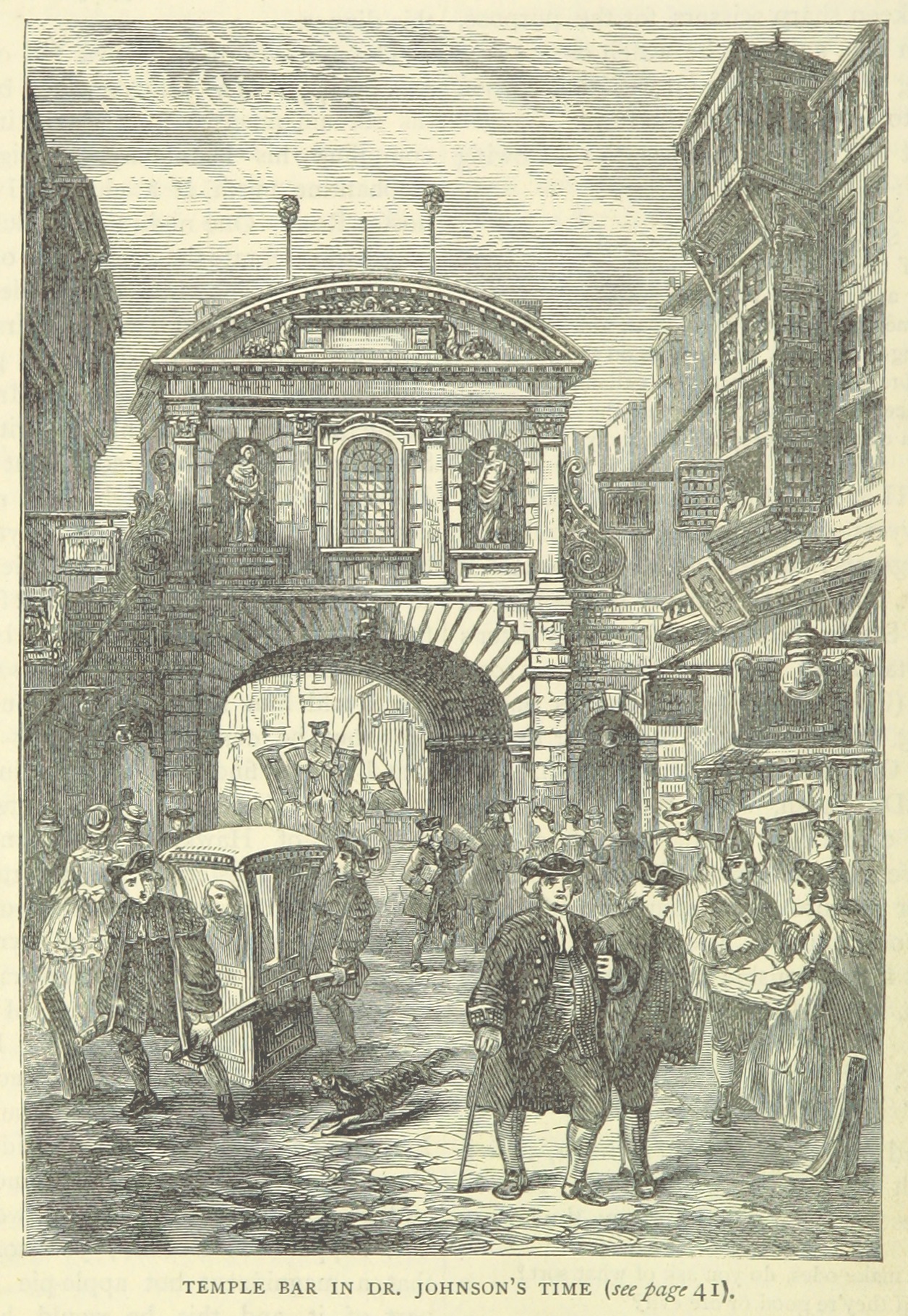
Temple Bar in Dr Johnson’s time, from Old and New London, 1887 (public domain, via Wikimedia Commons)
The stones were bought by Sir Henry Bruce Meux, 3rd Baronet, of the Meux brewing family, at the urging of his wife Valerie, Lady Meux. [3] [5] Valerie Langdon had been a banjo-playing barmaid at the Casino de Venise, a music hall in Holborn, where she performed as “Val Langdon”. She married the 22-year-old Henry in 1878, when she was about 26. She was famous for driving around in a carriage pulled by a pair of zebras. [5]

Sir Henry Bruce Meux and Lady Meux with her banjo, photographer unknown (public domain, via Wikimedia Commons)

Lady Meux was not the only person to use zebras to pull her carriage: Walter Rothschild (later 2nd Baron Rothschild), 1895. Photo: J. T. Newman (public domain, via Wikimedia Commons)
The arch was rebuilt as a grand gateway to the Meux estate at Theobalds Park, near Cheshunt in Hertfordshire. [4] [5] Neither her husband’s family nor polite society ever accepted Lady Meux. Even so, she entertained guests in the room above the arch, reportedly including the Prince of Wales and the young Winston Churchill. [5] [6] Sir Henry died in 1900 and Lady Meux in 1910. She left most of her fortune to Vice Admiral Hedworth Lambton, on condition that he change his surname to Meux. [5]

Temple Bar at Theobalds Park. © Christine Matthews, CC BY-SA 2.0
The arch stayed at Theobalds for more than a century and was damaged by weather and vandals. [6] The Temple Bar Trust, set up in 1976, bought it from the Meux Trust in 1984 for £1. Paid for largely by the City of London Corporation, it was taken down stone by stone from October 2003. It was rebuilt in Paternoster Square, next to St Paul’s Cathedral, and opened by the Lord Mayor on 10 November 2004. [3] [6]

Temple Bar in Paternoster Square today. © David Bradbury, CC BY-SA 2.0
Hear more stories like this on our Legal London walking tour of the Royal Courts of Justice and the Inns of Court.
[3] Temple Bar, London – Wikipedia
[4] London Remembers – Temple Bar
[5] Valerie, Lady Meux – Wikipedia
[6] Symbols & Secrets – Temple Bar and the banjo-playing lady